
The Hidden Cost of Stitched Digital Health Stacks
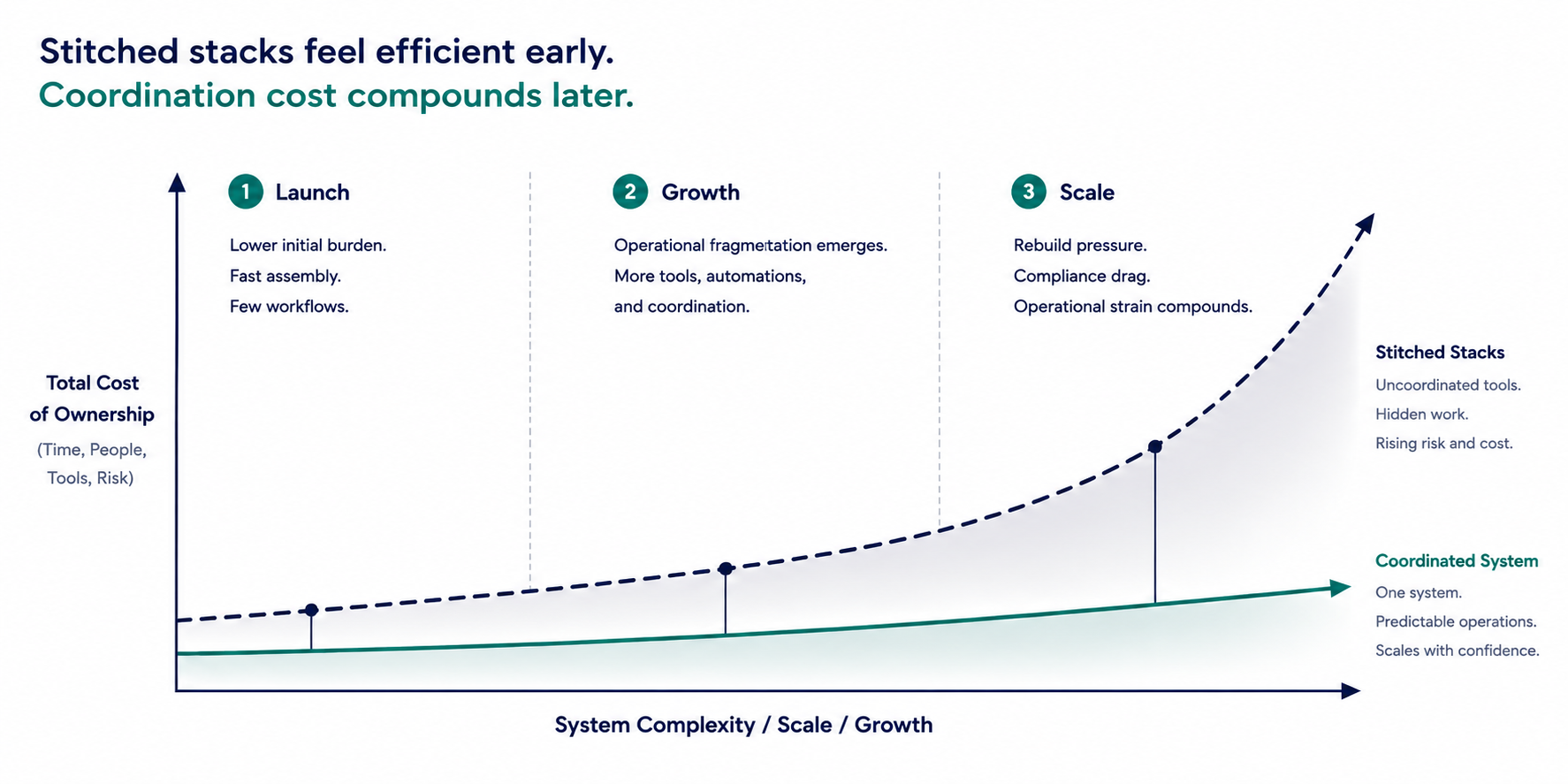
Many digital health organizations assume their operational problems come from missing capabilities. In practice, the problem is often the opposite. They already have the tools:
- Scheduling
- Messaging
- Payments
- Telehealth
- Forms
- Tracking
- EHR systems
- Automation
The issue is not capability scarcity, rather fragmented operational architecture.
Most digital health stacks evolve incrementally. A team starts with a few tools to get operational quickly. Then additional systems are added as the business grows. At first, this approach appears efficient. The organization avoids large upfront development costs and can move quickly. Over time, however, operational coordination complexity begins accumulating underneath the business.
Each new tool introduces additional:
- workflow dependencies
- operational states
- integration points
- synchronization requirements
- governance boundaries
- failure surfaces
The organization eventually reaches a point where operations teams become the glue holding the business together. This usually appears operationally before it appears architecturally. Teams notice:
- growing manual coordination
- increasing exception handling
- broken automations
- workflow gaps
- operational delays
- duplicated work
- inconsistent states across systems
Many organizations respond by adding more tooling. Ironically, this often increases the underlying coordination burden. The deeper issue is that integration is not the same as orchestration. Connecting tools does not automatically create a coordinated operational system. A scheduling system may know an appointment exists. A messaging platform may know a notification was sent. A payment system may know a transaction completed. But no single operational layer necessarily governs how the entire program operates together across tools and time.
This distinction becomes increasingly important as programs scale. What initially appears to be a flexible stack can evolve into:
- operational fragility
- growing maintenance overhead
- coordination strain
- workflow drift
- governance complexity
- scaling inefficiency
Many teams begin spending substantial operational energy simply maintaining continuity across operational workflows. Much of this effort produces no differentiated business value. It is consumed maintaining continuity between systems that were never designed to operate as one coordinated environment. This is one of the hidden costs of stitched digital health infrastructure.
The operational burden compounds gradually. At small scale, teams compensate manually. At larger scale, coordination itself becomes a major operational challenge and cost. The problem is not that the individual tools are inherently bad. The problem is that the business depends on coordinated execution while the underlying architecture remains fragmented. This is why the operational model matters.
Modern digital health programs increasingly require:
- longitudinal coordination
- workflow continuity
- governed execution
- operational visibility
- scalable orchestration across systems
This requires more than integrations. It requires a coordinated operational layer. As digital health programs continue becoming more complex, the organizations that scale most effectively are those with the most coordinated operational architecture.
Stratoum is designed around a new operational model. Instead of treating workflows, communications, services, and integrations as separate operational islands, Stratoum coordinates them as one governed system. This changes how digital health programs scale. Organizations can reduce:
- manual coordination
- infrastructure rebuilding
- operational fragmentation
- workflow brittleness
- growing automation sprawl
while keeping their existing tools and partners. This is the distinction between connecting tools and governing operations.
Stratoum operates as the orchestration layer coordinating workflows, communications, integrations, and operational logic across digital health programs while allowing organizations to retain their preferred tools and services. Most importantly, PHI remains inside customer-selected compliant systems while Stratoum coordinates operational continuity between them.