
Why Digital Health Companies Slowly Become Software Companies
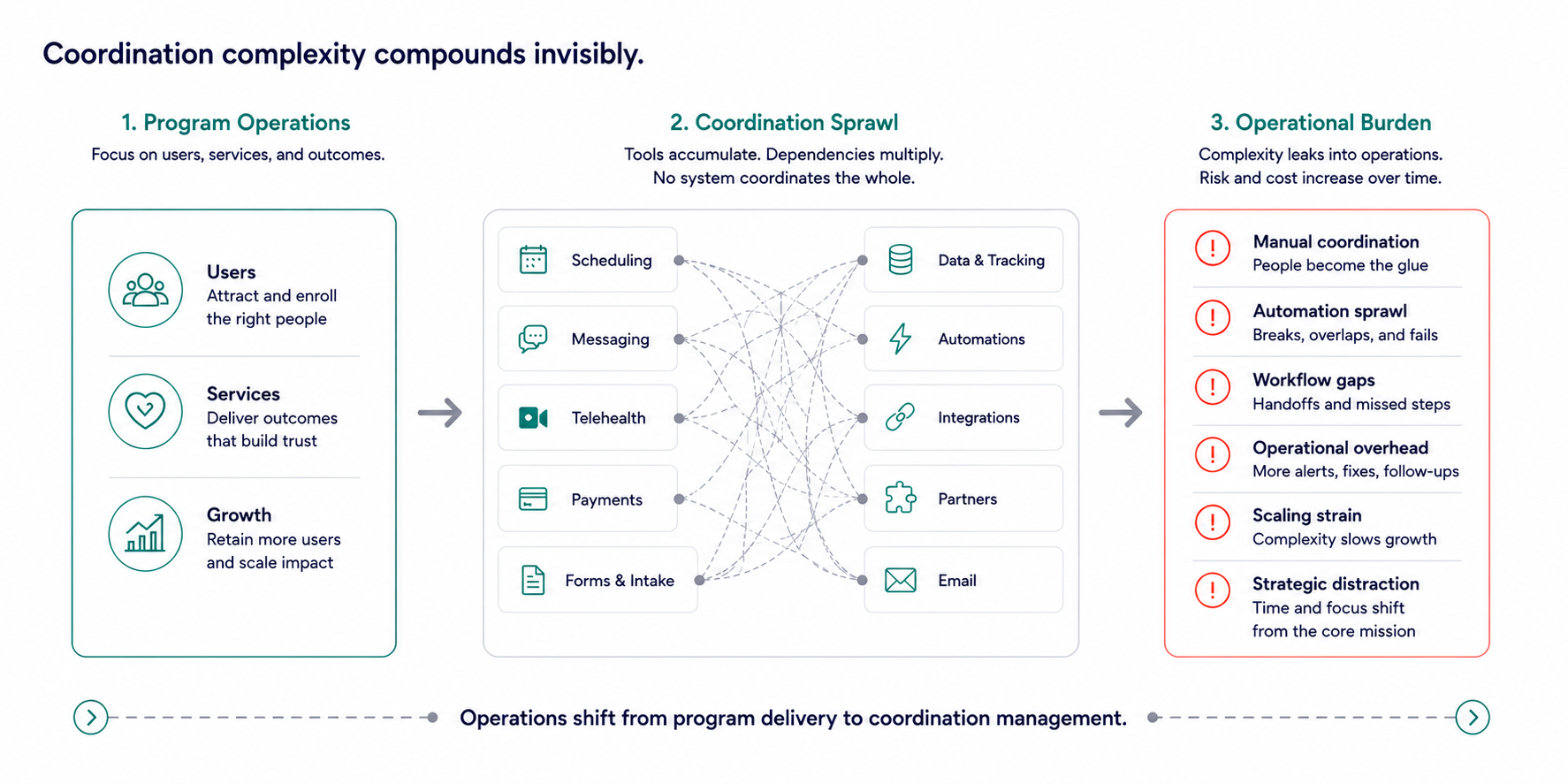
Many digital health and wellness founders believe they are building a health or wellness program. What they often end up building instead is a software operation. The shift usually happens gradually. At the beginning, the focus is on the visible parts of the business:
- services
- care delivery
- engagement
- coaching
- diagnostics
- onboarding
- AI
- outcomes
Then the operational layer underneath starts to grow. Scheduling must connect to onboarding. Messaging must coordinate with workflows. Payments must trigger operational states. Telehealth visits must synchronize with tracking and follow-up. Partner systems must operate together across time.
Initially, these problems appear manageable: a few integrations, some automations, a couple of operational workarounds, etc. But over time, the business accumulates operational coordination complexity underneath the customer experience. This is where many teams unintentionally become software companies. Not because they wanted to build infrastructure as a business. Over time, operational software maintenance and evolution quietly becomes part of the company’s identity and operating cost structure.
The issue is usually not that individual tools fail; scheduling, messaging, payments, telehealth, tracking, etc., each work individually. But the problem is that each operates independently while the program itself depends on coordinated execution across them. Integration does not automatically create operational coordination. Connecting tools is not the same as governing how the program operates across users, workflows, communications, and time.
As complexity grows, teams start compensating operationally:
- manual follow-up
- reconciliation across systems
- exception handling
- operational alerts
- workflow recovery
- growing automation layers
- internal coordination overhead
At this point, the organization begins allocating increasing operational and financial resources toward infrastructure coordination instead of differentiated business value. Most organizations do not initially realize they are taking on a long-term infrastructure burden when they begin stitching systems together. Once organizations begin stitching operational infrastructure together, they also inherit responsibility for maintaining, debugging, evolving, governing, and rebuilding it over time. Workflows change. Partners change. Compliance expectations evolve. New services are added. Operational logic expands.
What initially appeared to be a lightweight operational stack gradually becomes a continuously evolving infrastructure responsibility. Operational strain quickly appears:
- scaling becomes heavier
- workflows become fragile
- operational continuity depends on people
- changes become harder to implement
- coordination cost increases over time
As programs evolve, operational coordination becomes tightly coupled to day-to-day business execution. Workflows change constantly. New services and partners are added. Recovery logic expands. Operational exceptions emerge continuously. Over time, external vendors often become too slow, disconnected, or expensive to manage these evolving operational dependencies. Organizations gradually pull more operational infrastructure responsibility in-house because coordination itself becomes mission-critical to running the business.
Many teams assume this is simply the cost of growth. In reality, it is the consequence of fragmented operational architecture underneath the program. Modern digital health programs are not just a collection of applications. They are operational systems that involve:
- users
- services
- workflows
- communications
- data
- operational states
- partner systems
- longitudinal coordination
The program only works reliably if those components operate together as one coordinated system over time. This is why the underlying operational architecture matters so much.
Historically, digital health organizations have operated between two imperfect models, both of which shift substantial energy away from the actual program:
- Build and maintain custom infrastructure.
- Stitch together fragmented tools and manage the operational burden.
Both gradually force the organization to become a software company, the former from the start and the latter over time as coordination complexity grows.
Stratoum is designed around a new operational model, i.e., as the operating system for launching and operating digital health and wellness programs without requiring organizations to become software companies themselves. The goal is not simply connecting tools. The goal is coordinated operational execution across the entire program.
Instead of stitching together disconnected infrastructure, programs can now operate on a unified orchestration layer that coordinates workflows, communications, services, integrations, and operational logic as one system. The organization can stay focused on:
- services
- users
- outcomes
- programs
- growth
instead of absorbing increasing infrastructure complexity beneath the business. Stratoum enables organizations to stay focused on building their core instead of burning significant time and capital on non-differentiated infrastructure complexity.