Why Operational State Matters in Digital Health
Many digital health organizations believe their operational problems come from missing functionality. In practice, most already have the tools:
- scheduling
- telehealth
- payments
- messaging
- forms
- tracking
- EHR systems
- automation tools
The problem is usually not capability scarcity. The problem is that no operational layer governs state continuity across the full lifecycle of the program. This distinction becomes increasingly important as digital health programs grow.
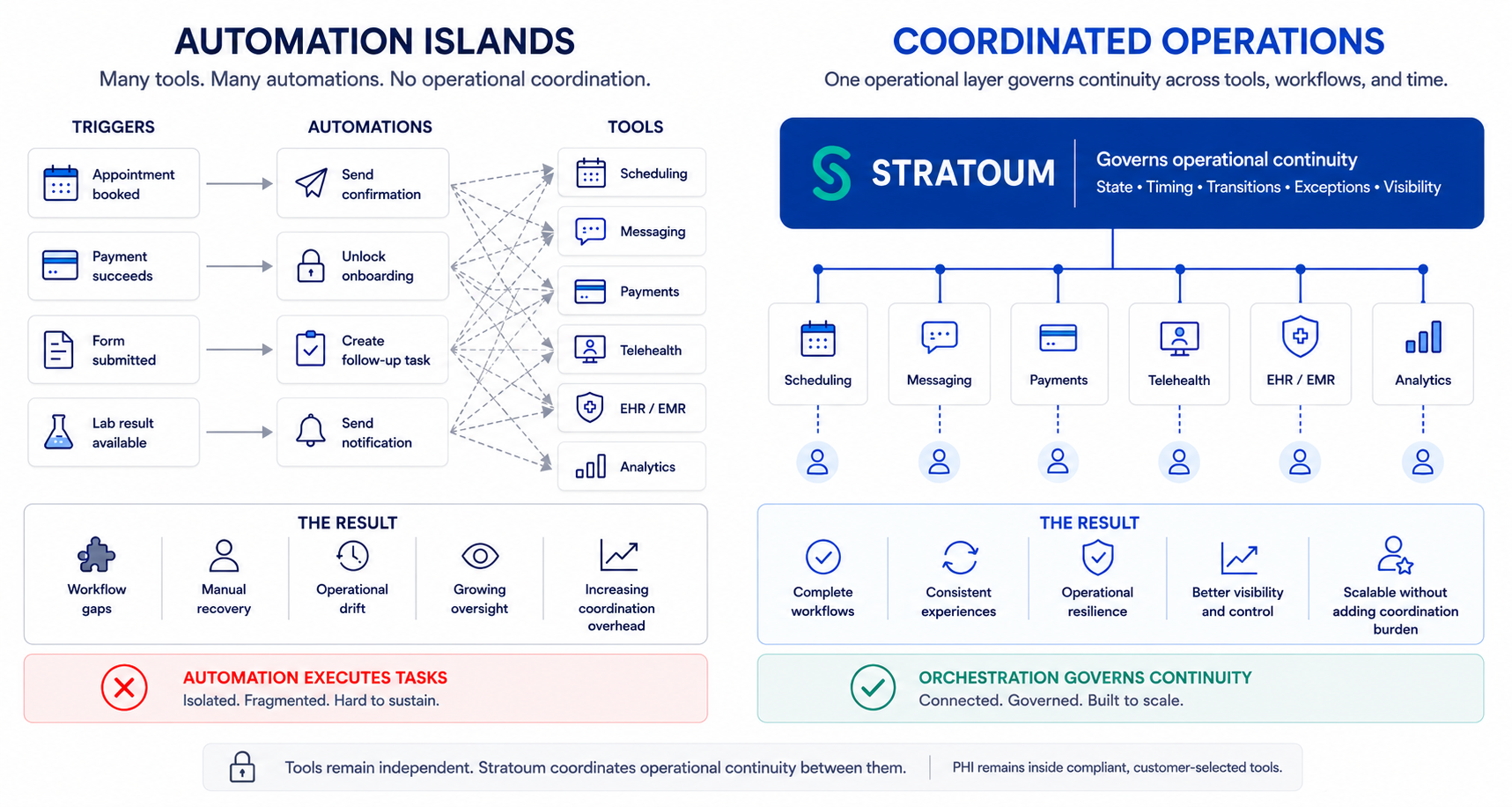
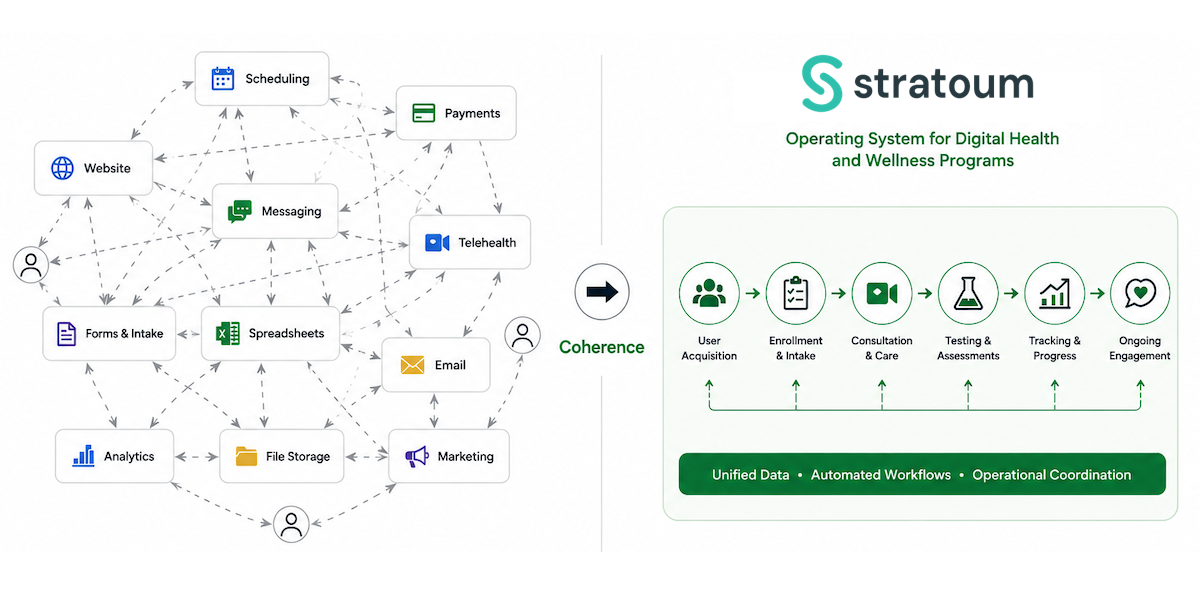
Most digital health systems are built incrementally. A scheduling platform is added. Messaging gets connected. Payments trigger onboarding. Tracking systems are layered in later. Over time, the business accumulates workflows, integrations, automations, and operational dependencies across many systems. Initially, this often appears manageable. Each tool works individually. Each workflow appears functional independently. But digital health programs do not operate as isolated actions. They operate as longitudinal operational systems across users, services, workflows, communications, and time. This exposes a deeper operational state problem.
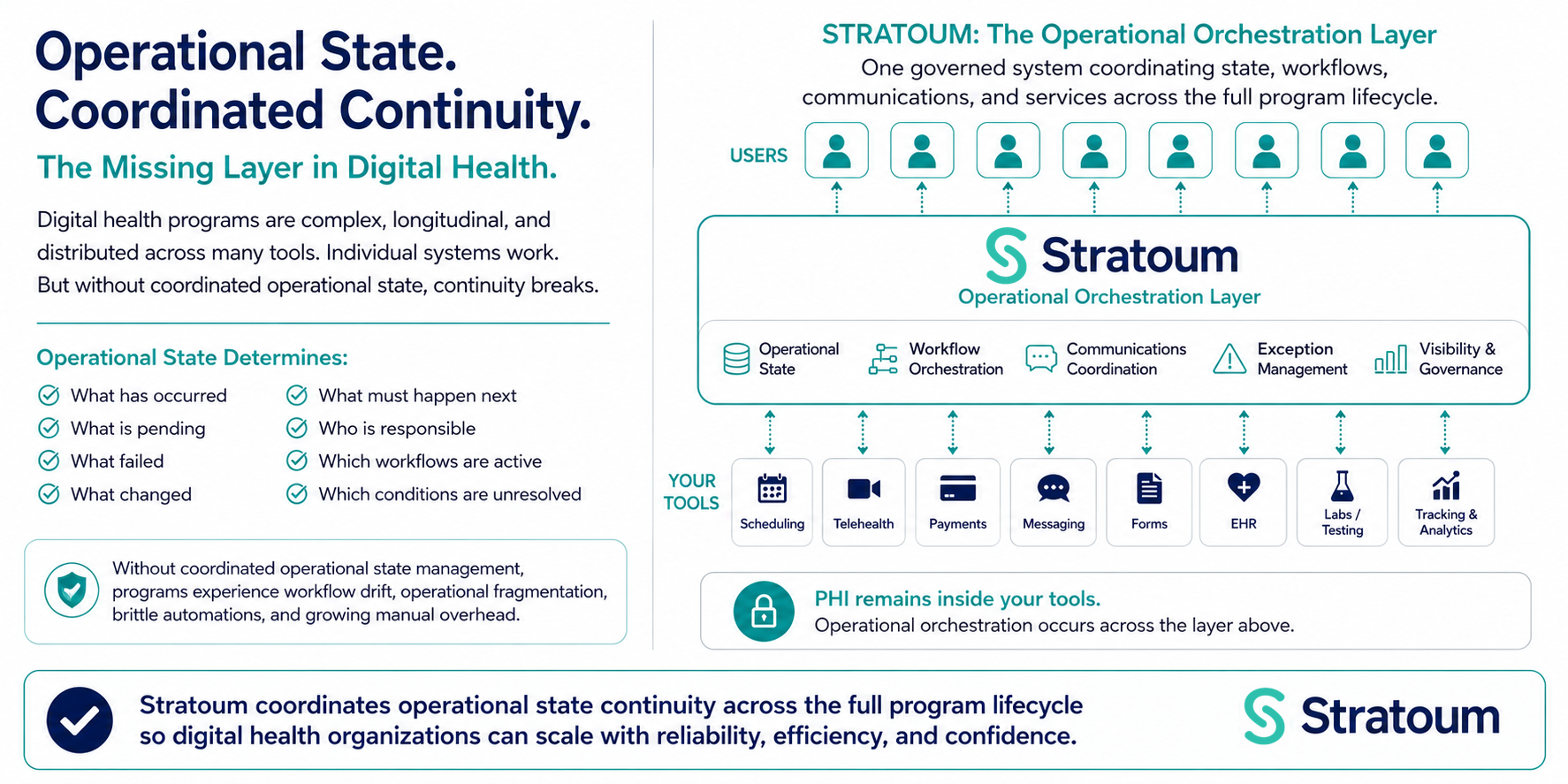
Operational state is the continuously evolving condition of the program and the user journey across the system. It represents the operational reality of the program at any point in time and determines:
- what has occurred
- what is pending
- what failed
- what changed
- what must happen next
- who is responsible
- which workflows are active
- which operational conditions are unresolved
Without coordinated operational state management, programs increasingly depend on fragmented awareness distributed across disconnected tools, automations, dashboards, spreadsheets, alerts, and people. This is where operational continuity begins degrading.
For example,
- a consultation is rescheduled, but downstream reminders do not update correctly.
- a payment succeeds, but onboarding remains incomplete.
- testing is delayed, but follow-up workflows continue triggering.
- a user misses a consultation, but operational recovery depends on manual intervention.
- an automation executes successfully in one system while another system remains out of sync.
None of these failures necessarily originate from defective tools. They occur because no operational layer governs continuity of state across the full workflow lifecycle.
As complexity grows, organizations often compensate operationally by:
- manual follow-up
- exception handling
- workflow recovery
- spreadsheet coordination
- duplicate checks
- cross-system reconciliation
- growing automation layers
At small scale, teams can often absorb this operational burden manually. At larger scale, continuity itself becomes increasingly difficult to maintain. This is one reason digital health programs often become operationally heavy long before they become clinically or commercially mature.
The issue is not merely integrations. Integration moves information between systems. Operational orchestration governs continuity across the entire program, i.e., workflows, transitions, dependencies, communications, exceptions, and time. This requires coordinated operational state management. Without it, organizations experience:
- workflow drift
- operational fragmentation
- brittle automations
- hidden manual labor
- inconsistent user journeys
- scaling strain
- growing governance complexity
The deeper issue is architectural. Most operational environments were never designed to coordinate the entire lifecycle of a digital health program as one governed operational system. As programs scale, operational state becomes increasingly important because digital health involves:
- longitudinal engagement
- distributed workflows
- multi-system coordination
- partner dependencies
- communications across time
- compliance boundaries
- operational recovery paths
- human and automated interactions
The more these systems evolve independently, the more difficult continuity becomes without orchestration.
Stratoum is designed around this operational model. Instead of treating workflows, communications, integrations, and services as isolated operational islands, Stratoum coordinates operational state continuity across the full program lifecycle as one governed system.This changes how programs scale. Operational continuity becomes governed structurally instead of reconstructed manually across fragmented tools and workflows.
Most importantly,organizations can retain their preferred tools, while Stratoum coordinates operational continuity between them. PHI remains inside their tools, while operational orchestration occurs separately across the layer above them. This architectural distinction becomes increasingly important as digital health programs evolve from isolated workflows into continuously operating systems.