Why Scaling Digital Health Programs Creates Operational Strain
Many digital health and wellness programs start with a few dozen users, a specific workflow, and some automations. At this stage, teams can compensate manually when problems appear:
- Missed onboarding? Someone follows up.
- Workflow gap? Someone checks the dashboard.
- Automation issue? Someone intervenes.
But as programs grow, something important changes. Operational coordination complexity increases faster than the visible business itself. This is one of the least discussed scaling problems in digital health.
Many teams assume growth primarily creates more:
- users
- data
- services
- engagement activity
However, growth creates disproportionately more coordination burden in operations. More users mean more:
- workflow states
- operational transitions
- exception paths
- synchronization events
- communications
- recovery scenarios
- partner coordination
When the underlying operational architecture remains fragmented, the organization begins absorbing increasing operational strain.
This operational strain appears gradually. The program does not suddenly fail. Instead:
- workflows become heavier
- operations team becomes more reactive
- manual intervention increases
- automation layers multiply
- reliability becomes harder to maintain
- scaling begins feeling operationally expensive
Many organizations interpret this as an unavoidable consequence of growth. Often, however, it is a consequence of the architecture underneath the growth.
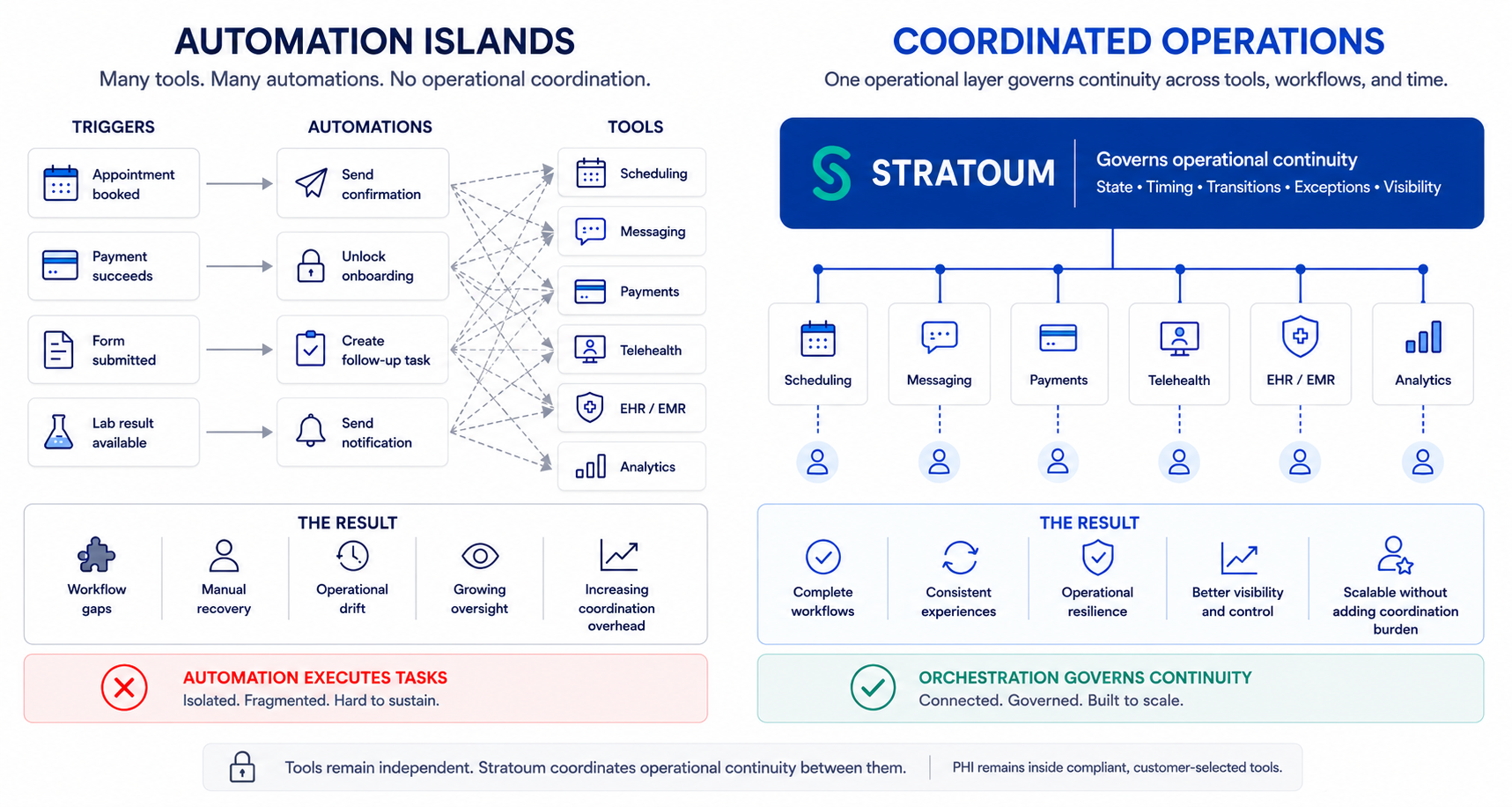
The cause is not merely growth. It is scaling fragmented coordination models. This distinction matters. Most stitched operational systems depend on:
- distributed logic
- disconnected operational states
- integrations without centralized orchestration
- operational recovery through people and processes
At smaller scale, these weaknesses remain partially hidden. At larger scale, they become increasingly visible. The issue is not that operational work increases. The issue is that coordination complexity often grows faster than the business itself. Integration alone does not create coordinated operational execution across the program. This is why many organizations eventually feel trapped between two undesirable paths:
- Continue accumulating operational complexity.
- Rebuild operational infrastructure.
Neither is attractive.
The deeper problem is that most operational architectures were never designed for sustained coordinated execution across growing digital health systems. Modern digital health programs involve:
- services
- communications
- partner systems
- workflows
- longitudinal engagement
- compliance boundaries
- operational governance
The more these components scale independently, the more important coordinated orchestration becomes.
This orchestration is especially important in healthcare because operational continuity affects:
- users
- user experience
- engagement
- operational cost
- reliability
- governance
- scalability
As the industry matures, operational coordination may become one of the most important determinants of which digital health organizations scale efficiently with growth and over time.
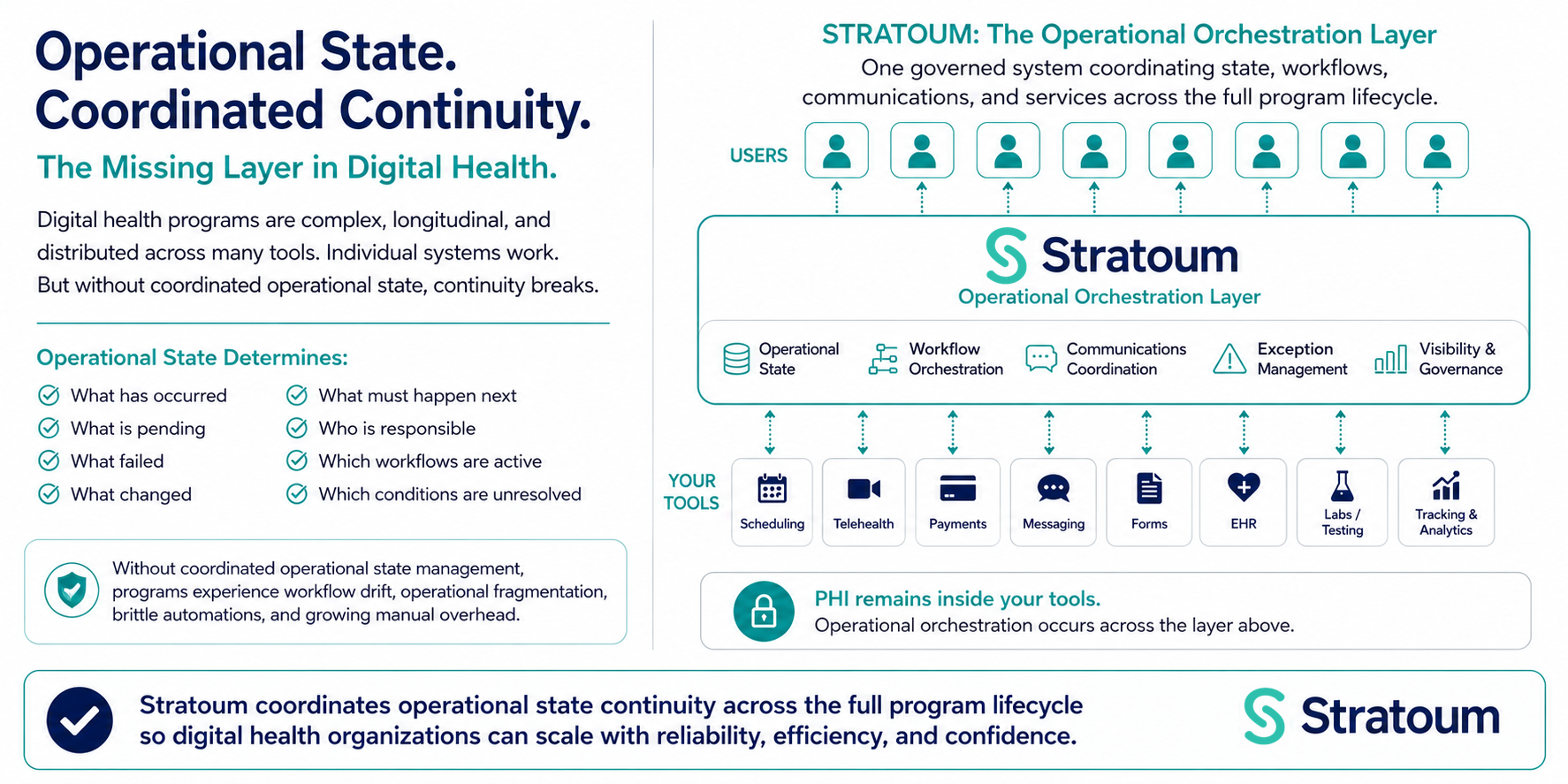
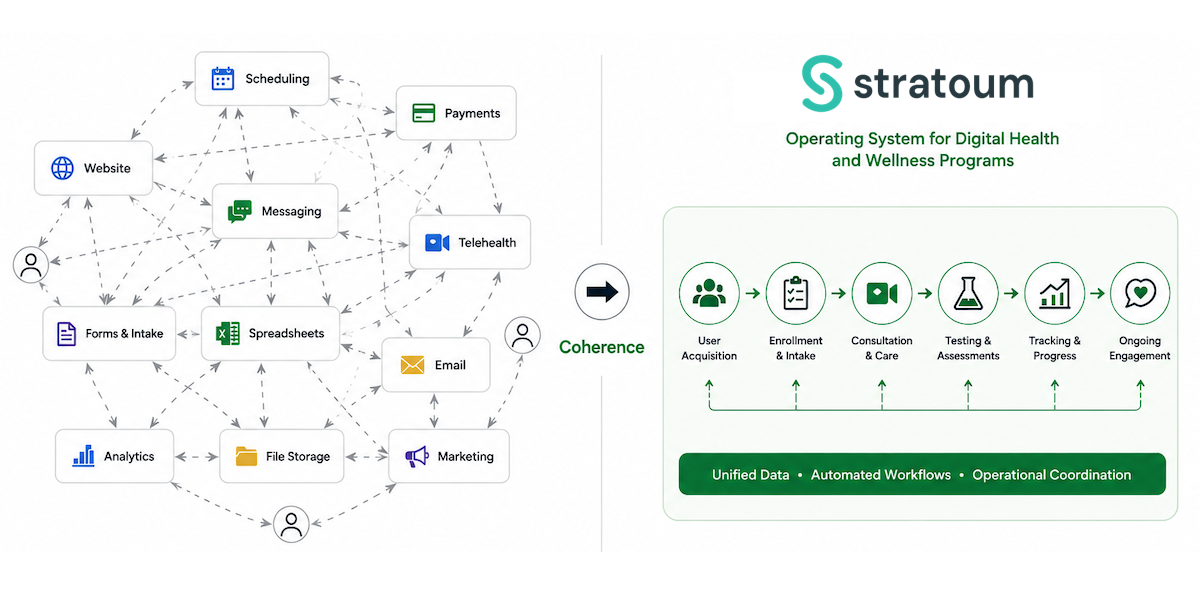
Stratoum is designed around this new operational model, i.e., the entire program running as one coordinated system. Stratoum coordinates workflows, communications, services, integrations, and operational continuity as one operating system so digital health organizations can scale programs without becoming software infrastructure operators themselves. Programs no longer need to rely on fragmented coordination across disconnected tools. This changes the scaling behavior of the program. Operational coordination becomes governed structurally rather than compensated manually.
Most importantly, Stratoum also allows organizations to avoid unnecessary expansion of PHI handling complexity. PHI can remain inside compliant customer-selected tools while operational coordination occurs separately. This reduces:
- compliance surface expansion
- operational overhead
- governance complexity
- infrastructure migration burden
while improving operational continuity. This architectural distinction is becoming increasingly important as digital health programs evolve in complexity.